
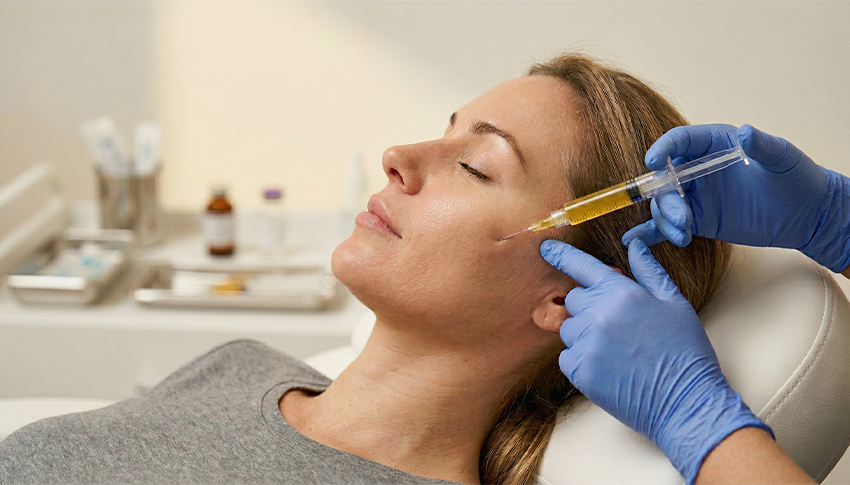
Face PRP treatment is an efficient and natural facial rejuvenation treatment to regain your youthful appearance. The treatment uses chemicals in your blood to revitalize and refresh your skin without any surgeries. Just after one session of face PRP treatment, your skin will look smoother, brighter, and fresher!
Continue reading to learn more about face PRP treatments.
What is Face PRP Treatment and How Does it Work?
This is a natural treatment. Oxygen, nutrients, blood cells, and many other elements are distributed throughout the body by plasma, the liquid portion of blood. The mending process depends on platelets, which are blood cells. They produce chemicals that stimulate the cells responsible for tissue regeneration in addition to helping to close skin cracks.
In order to produce PRP, which is utilized in well-known cosmetic procedures like the vampire facelift, your skin specialist will extract the platelet-rich portion of your blood from a small sample. The platelets are triggered when PRP is injected into your skin, initiating a sequence of events that eliminate damaged tissue, encourage the production of new skin cells, and boost collagen synthesis.
Additionally, face PRP will encourage the synthesis of hyaluronic acid, which draws water and plumps up thinning or depressed areas of the skin. Collagen and hyaluronic acid work together to treat fine wrinkles, atrophic acne scars, and other similar lesions. After your procedure, you’ll notice that your skin appears more radiant and smooth.
The Procedure
Here’s what your face PRP treatment procedure will look like.
Extraction of Blood
A small amount of blood, roughly 10–60 milliliters, or 1–4 tablespoons, will be taken from your arm by your skin specialist. The process is similar to taking a blood sample for examination.
Preparing PRP
Your skin specialist will put the blood in a tube with an anticoagulant drop to avoid clotting. Centrifuging the fluid will separate the platelets from the red and white blood cells. Face PRP preparation could take up to 30 minutes.
Cleaning of Treatment Area
The dermatologist will thoroughly clean the region to make sure there are no bacteria that could complicate your face PRP procedure.
Application of Topical Anesthetics
Some people may experience pain from a PRP injection, even when tiny needles are used. If your pain threshold is low, your doctor will apply some numbing lotion to the area prior to injecting the fluid.
Identifying the Target Area
The expert will mark the treatment location to ensure the precision of the platelet-rich plasma.
Injection of PRP
The doctor will inject PRP into the skin using a minuscule needlepoint. The full course of therapy may take up to an hour, depending on the severity of your skin condition.
How Much Pain Does a PRP Facial Cause?
Face PRP injections usually cause tolerable pain. You could ask your doctor to use some numbing lotion on the treatment area so that the platelet-rich plasma facial is absolutely painless. After the medicines wear off, you might have some localized soreness for a few days.
What Can You See Immediately Following a Face PRP Treatment?
Expect the following after a PRP facial:
- Pain at the injection site
- Swelling
- Redness
- Determine any bleeding
These show that the therapy is working. They might linger for a few days, but they usually disappear on their own.
What Can You Anticipate During the Recovery Phase?
This article covers the most important aspects of the recovery period following a face PRP.
Potential Side Effects
The most common side effects of face PRP treatment include pinpoint bleeding, edema, redness, and soreness at the injection site. Vulnerable patients may also experience some bruising. Uncommon side effects include allergies to numbing creams, infections, headaches, and skin discolorations. It is unlikely that hypersensitivity will develop on its own because PRP is derived from your blood. Infection is also uncommon because of PRP’s antimicrobial properties, especially with diligent aftercare.
Recovery Time
There is extremely little recovery time after a face PRP injection. Avoiding physically demanding activities during the first few days lowers the chance of harm to the treated area, even though the initial side effects are tolerable. Additionally, by briefly limiting your activities and avoiding putting significant pressure on your face, you can extend the fluid’s presence at the site because tissues absorb PRP.
Sessions
The number and frequency of follow-up treatments depend on how serious your skin condition is. However, three to four sessions spaced four to six weeks apart are typically required for the initial course of therapy. For the majority of patients, maintenance can be achieved with twice-yearly treatments.