
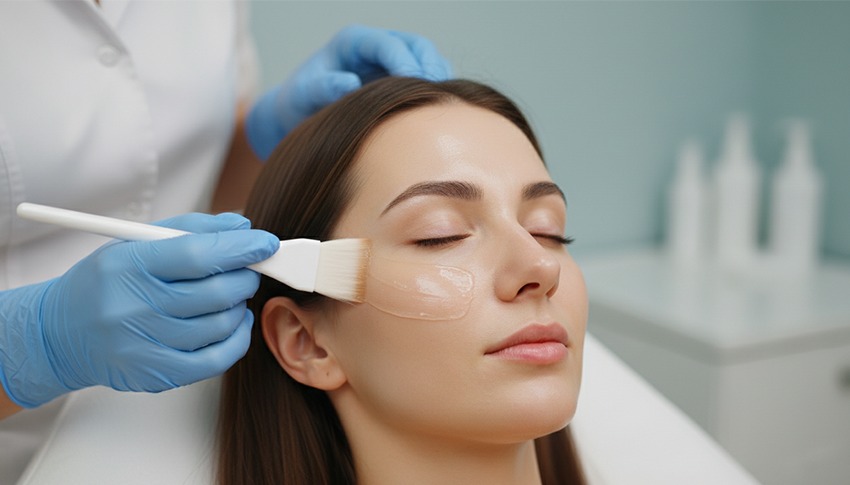
For many people, the word “chemical peel” conjures up terrifying images of women with red, raw, and blistered faces on the Internet. As a result, many individuals have fled at the mere idea of a chemical peel due to images such as those on the Internet. On top of that, there is a vast amount of false information available online that continues to scare individuals from getting chemical peels. And that is why we’re here to help you today.
We’ve outlined some of the most common myths about chemical peels to help you make an informed decision.
What Are Chemical Peels
Chemical peels are cosmetic procedures that use an acidic solution to exfoliate the skin, removing dead cells and revealing brighter, smoother skin. They aid in the treatment of issues like melasma, sun damage, acne, fine wrinkles, and uneven skin tone.
There are three types of chemical peels:
- Mild acids are used in superficial peels, which require little to no recovery time.
- Medium peels help with wrinkles and pigmentation by focusing on deeper layers.
- Deep peels, which are typically performed in cooler months, address more serious issues and require more recuperation.
Despite their widespread use, many people are unsure about whether peels are safe to acquire in the summer and how they react to sun exposure. So, let’s look at the most common myths.
Myth: Never Get Chemical Peels in Summer
One of the most widespread misconceptions about chemical peels is that you should never get a peel in summer. While it may be true that your skin may become more vulnerable to sunlight after a chemical peel, you must remember that every chemical peel has a different formulation. Thus, summertime is a safe time to get a superficial chemical peel, especially if you wear sunscreen.
Depending on the time of year and your lifestyle, skincare professionals frequently modify the kind and intensity of peels. You may receive a chemical peel in the summer without risk and still get fantastic results if you follow the aftercare guidelines, which include applying sunscreen and avoiding direct sunlight.
Myth: You’ll Get Too Sensitive to Sunlight After Peeling
It is true that chemical peels make your skin more sensitive to sunlight, especially during the initial days following the procedure. However, this does not imply that being outside would damage your skin. Remember, the most important thing is how you handle sun exposure following a chemical peel. Therefore, while your skin recovers, you can prevent sun damage by wearing protective clothing and a hat, avoiding peak sun hours, and using a broad-spectrum sunscreen with an SPF of 30 or higher.
Myth: Every Peel Offers the Same Results
Every peel may be different, even for the same patient. Different people react differently to the same type of peel depending on a variety of circumstances, including the frequency of peel treatments and the state of the patient’s skin. Furthermore, because chemical peels only target the outermost layer of the epidermis, any extrinsic variables that affect the epidermis can affect the outcome after treatment. This implies that, depending on the condition of your skin, you can get the same peel yet experience a different reaction, such as less or slightly more peeling.
Myth: It is Not Safe to Get a Peel If You’ve Been in the Sun
Chemical peels are not always ruled out by recent sun exposure. However, it does require careful evaluation by your dermatologist. Your appointment might need to be rescheduled if you have recently been sunburned or if your skin is already irritated. However, a slight tan or a little time spent outside does not automatically make you an unsuitable candidate for a chemical peel. Thus, for this reason, consultation is crucial. A qualified professional will evaluate your skin’s state and decide whether a peel is suitable at this time or if you should wait a few days.
Myth: Chemical Peels Are Very Painful
Although some tingling or discomfort may occur during the procedure, chemical peels are usually well tolerated. Depending on the type and strength of the chemical peel, different people will experience different levels of discomfort. Certain peels, such as phenol or TCA peels, have the potential to reduce pain by acting as an anesthetic. Whereas alpha-hydroxy acid peels and other milder peels could sting a little while being applied. In general, the majority of patients report that any discomfort they may experience during a chemical peel is mild and goes away quickly once the procedure is over.