
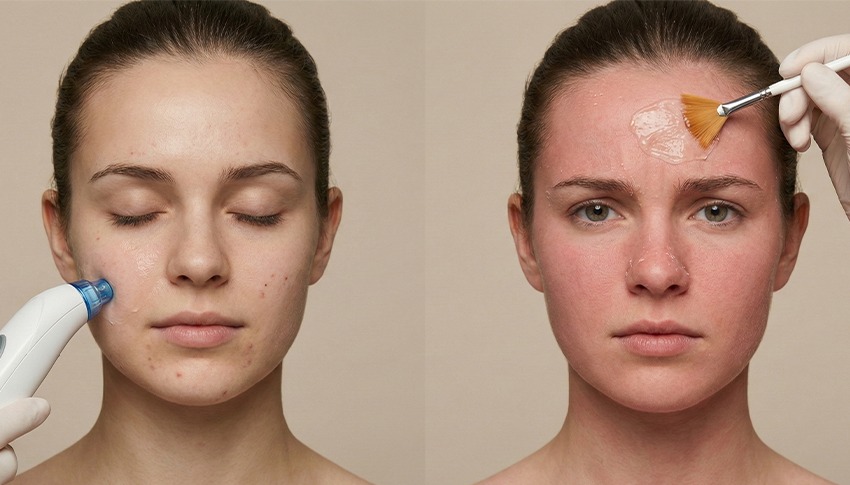
Chemical peels and HydraFacials are the two keywords that are most frequently mentioned when discussing professional skincare procedures. Both are commonly performed, guarantee brighter, clearer skin, and are carried out in clinics all over the world, but they operate entirely differently. While one concentrates on removing damaged layers to expose a new surface underneath, the other focuses on moisturizing, cleaning, and nourishing the skin barrier. As a result, people frequently struggle to decide which choice is best for their skin type. So, which is one is the best choice for you? Read this guide to find out.
What is HydraFacial?
Using vortex-suction technology, a Hydra facial is a mild, multi-step procedure that cleans, exfoliates, extracts, and hydrates the skin. A gentle exfoliating solution is used to remove debris and dead skin, and then a painless suction is used to unclog congested pores. The final stage leaves the skin feeling hydrated and renewed by deeply hydrating it with peptides, hyaluronic acid, and antioxidants. A Hydrafacial is suitable for practically all skin types, including sensitive, acne-prone, and dry skin, because it strengthens the skin barrier rather than strips it away like harsher treatments do.
After the treatment, the majority of people report an immediate glow, tighter pores, smoother texture, and a clean, renewed appearance. But rather than bringing about significant change, the outcomes focus more on preserving the health of the skin. It can prevent congestion, lighten dull skin, and maintain long-term skin balance when done on a regular basis, usually once a month. If you want a hydrated glow with no recovery time, Hydrafacial provides reliable, consistent results without danger, recovery time, or irritation. Because it gives the appearance of “fresh skin” in just one session, it is frequently chosen prior to events, weddings, or trips.
What Are Chemical Peels?
In order to show fresher, clearer skin, chemical peels exfoliate the epidermis by applying an acidic solution. There are three levels of intensity. Only the outer epidermis is targeted with light peels like lactic acid, glycolic, salicylic, and mandelic acid. With minimal to no downtime and only slight flaking, they help with dullness, oiliness, minor acne, and surface pigmentation.
The top dermis can be penetrated with medium peels. Although they require aftercare and around a week of noticeable peeling, they are perfect for deeper pigmentation, facial wrinkles, acne scars, and long-term sun damage.
Deep peels are used for deep scars, etched lines, and extreme wrinkles. Although they have life-changing effects, they also require weeks of rest and close medical attention. They are quite successful for resistant skin issues because they purposefully remove damaged skin to allow it to recover. To prevent complications, they also need time to recuperate, patience, and expert advice.
Which Treatment is Better: Chemical Peel or HydraFacial?
Here are some major differences in chemical peels and HydraFacial.
Efficiency
For immediate brightness, moisture retention, congestion, and moderate textural problems, HydraFacial works wonders. Although it remains on the surface, it offers rapid, noticeable improvement. Because they operate deeper and promote regeneration, chemical peels—especially medium and deep versions—are more helpful for pigmentation, scars, wrinkles, and long-term damage. Peels are more effective if transformation is the aim; Hydrafacial is best if upkeep is the aim.
Recovery & Downtime
With HydraFacial, there is no downtime no irritation, no peeling, and no limitations. Recovery from chemical peels varies in intensity: small peels result in mild flaking, medium peels take roughly a week, while severe peels require weeks of healing and rigorous sun protection. Peels win for more profound alteration, but HydraFacials win for ease of use.
Concerns & the Ideal Skin Type
HydraFacials work well for combination, dry, reactive, and sensitive skin types. It works well for maintenance, breakouts, and dullness. Peels work well for aged, pigmented, scarred, greasy, and acne-prone skin. For darker skin tones, medium and deep peels should be carefully selected to prevent hyperpigmentation. In simple words, mild skin problems require a Hydrafacial, whereas stubborn skin problems require a chemical peel.
Lasting Results
Regular sessions are necessary to preserve the radiance after a HydraFacial, which usually lasts one to four weeks. While medium chemical peels might produce results for months, light chemical peels typically last a few weeks. Because deep peels rebuild deeper layers of the skin, they can yield effects that last for years. This means that peels may be more severe but also last for longer.
Thus, both HydraFacials and chemical peels are amazing cosmetic treatments. But what will work best for you depends largely on your skin type, your objectives, and even your lifestyle. To help you choose the best therapy for your circumstances, look at the above-mentioned procedures, their variations, and contrast them based on important factors like results, efficiency, etc.