
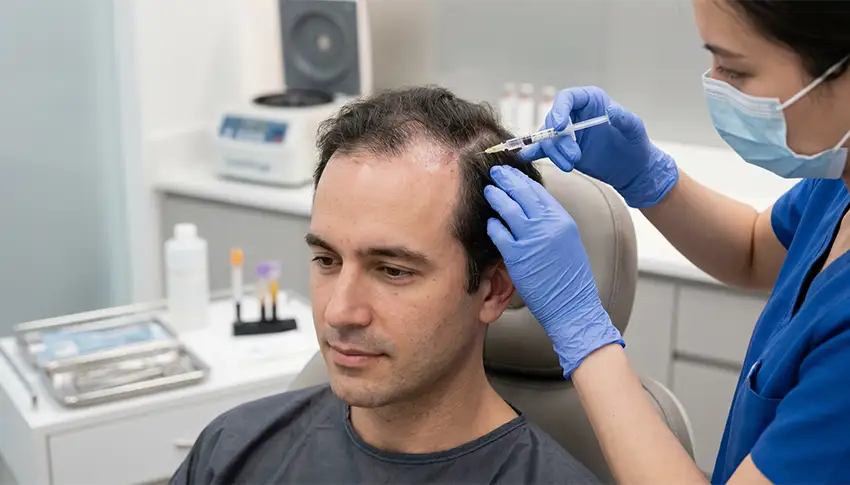
Have you tried every hair hack on social media, hair oils, and the onion juice your aunt uses, but still see thinning hair and no lasting results? You’re not alone! Maybe it’s time to think about alternatives to home cures. This is where hair PRP treatment steps in as a tried-and-true, all-natural method of restoring hair health.
If you want to learn more about hair PRP treatment, read this guide.
What is Hair PRP Treatment?
Using the patient’s own blood, PRP (Platelet-Rich Plasma) hair treatment is a regenerative medical therapy that encourages the creation of new hair. Growth factors found in platelets promote tissue regeneration, boost blood supply to hair follicles, and extend the hair growth cycle. Using hair PRP treatment on people with early-stage hair loss, thinning hair, heavy shedding, and pattern baldness, when hair follicles are still active but weak, yields the best results.
How Does Hair PRP Treatment Work?
We must examine the hair growth cycle in order to comprehend the question, “Does PRP work for hair loss?” The phases of growth (anagen), regression (catagen), and rest (telogen) are experienced by hair follicles. Follicles shrink (miniaturize), and the growth phase shortens in diseases such as androgenetic alopecia (pattern baldness). PRP injections for hair loss function by directly supplying the follicle root with a high concentration of growth factors. These elements consist of:
- Platelet-Derived Growth Factor (PDGF): Encourages cell division and the growth of blood vessels.
- Vascular Endothelial Growth Factor (VEGF): Provides more oxygen and nutrients to the hair follicle by increasing blood flow.
- Transforming Growth Factor (TGF): Promotes matrix synthesis and cell proliferation.
Hair PRP treatment seeks to enhance the diameter of existing hair strands, extend the period of hair development, and force resting follicles back into the growth phase.
The typical hair PRP treatment process is intended to be rapid, secure, and comfortable. Usually, the entire appointment takes 45 to 60 minutes.
- Blood Draw: Like a typical conventional blood test, your doctor will start by taking a tiny sample of blood from your arm, usually between 10 and 30 milliliters.
- Centrifugation: A specialized centrifuge machine is used to hold the blood. This device separates the blood components according to density by spinning at a high speed. The platelet-rich plasma rises to the top while the red blood cells sink to the bottom.
- Extraction: After eliminating the red blood cells, they will carefully remove the concentrated platelet-rich plasma.
- Injection: The specialist injects the PRP into the thinning areas of the scalp using a very tiny needle. To reduce any discomfort during this procedure, we could employ a cooling device or a local anesthetic.
What Hair PRP Can and Cannot Do?
For contentment, controlling expectations is essential. To prevent disappointment, it’s critical to comprehend the limitations of PRP hair treatment.
What hair PRP Can Do: It can improve the general health of the scalp, thicken fine hairs, and reduce the incidence of genetic hair loss. It works wonders for “waking up” sluggish follicles.
What hair PRP can’t do: It can’t bring a dead follicle back to life. PRP won’t produce hair in a region of your scalp that is entirely smooth and glossy (a sign of no active follicles). Additionally, maintenance is necessary to maintain the benefits; it is not a permanent remedy.
Ideal Candidates for Hair PRP Treatment
You are probably a strong candidate if:
- You Have “Active” Hair Loss: You still have hair in the area, but you have recently noticed thinning or a widening part line.
- You Have Alopecia Areata: Patients with this autoimmune disease may find that PRP helps to promote regrowth in patchy places.
- You Are Postpartum: Because PRP helps restart the hair cycle, women who have hair loss after giving birth frequently get great results.
- You Exhibit Miniaturized Hairs: Upon closer inspection, the thinning spots exhibit tiny, thin hairs. PRP stimulation’s main aims are these.
Who Shouldn’t Get Hair PRP Treatment?
- Advanced Baldness: PRP by itself will not provide cosmetic coverage for patients with a Norwood Scale 5 or higher (significant baldness).
- Blood Disorders: Patients with chronic liver illness, low platelet counts, or heavy blood thinners may not be appropriate for this medication because it depends on your blood.
- Lifestyle Factors: Because nicotine narrows blood vessels, which negates the benefits of the treatment, heavy smokers may see diminished results.
- Underlying Medical Conditions: Patients with lupus, thyroid issues, or uncontrolled diabetes should take care of their primary illness first.