
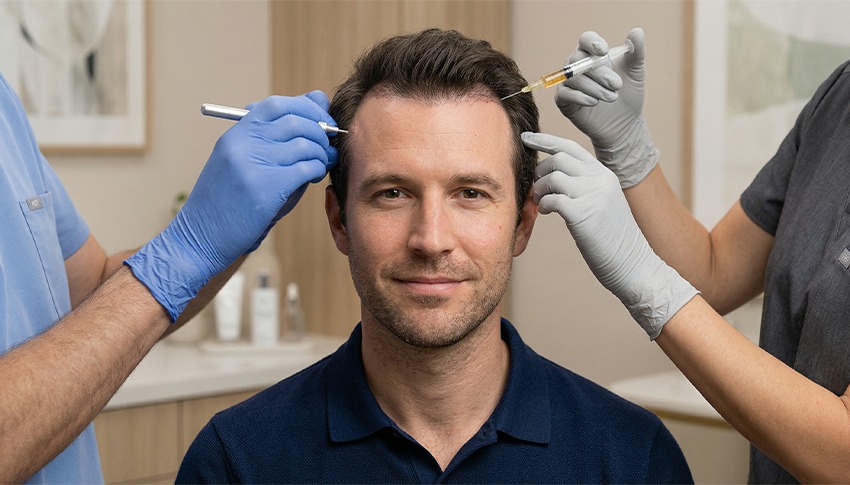
For many people, having a full head of hair is a source of identity and self-confidence in addition to being a feature of their look. Unfortunately, millions of people worldwide suffer from hair loss, which causes them distress and motivates them to look for answers. Hair restoration procedures and hair transplants are the two main ways to deal with hair loss.
This guide outlines the differences between hair transplant and hair restoration to help you decide which one could be more suitable for you.
Hair Transplant
As a successful and long-lasting remedy for hair loss, hair transplants have become incredibly popular in recent years. In this surgical treatment, hair follicles from a donor area, typically the back of the head, are transplanted into bald or thinning areas.
FUT and FUE are the two methods used for hair implantation.
- FUT: Individual hair follicles are retrieved and implanted into the recipient site after a strip of hair-bearing skin is removed from the donor area. This results in a linear scar at the donor site that the surrounding hair may cover over.
- FUE: FUE does not require a strip of skin in order to remove individual hair follicles. Compared to FUT scars, it leaves tiny, circular scars that are less obvious. Because FUE is less intrusive, it is often chosen.
Pros and Cons
Here are some pros of hair transplant.
- Permanent Solution: A long-term or permanent remedy for hair loss is provided via hair implants. The transplanted hair is a long-lasting treatment because it is resistant to the hormone that causes pattern baldness.
- Low Maintenance: The transplanted hair requires very little care after it has fully grown. It can be styled, cut, and washed just like ordinary hair.
- High Success Rate: FUE and FUT, two contemporary hair implant methods, have a high success rate and typically yield positive outcomes.
- Low Maintenance: The transplanted hair needs very little upkeep when it has fully grown. It can be styled, cut, and washed just like ordinary hair.
- High Success Rate: FUE and FUT, two contemporary hair implant methods, have a high success rate and typically yield positive outcomes.
- Increases Confidence: Restoring your hair can significantly improve your confidence and sense of self-worth by making you feel better about the way you look.
- No Ongoing Costs: A hair implant is a one-time investment, in contrast to several hair loss treatments that call for ongoing purchases of drugs or products.
- Natural Appearance: The transplanted hair feels and looks just like your natural hair. It looks incredibly natural because it mixes in perfectly with your natural hair.
Here are some cons of hair transplants.
- Expensive: Depending on the clinic and the degree of hair loss, hair implants might be costly. Some people may not be able to afford the surgery.
- Surgery: There is a certain amount of risk associated with hair implants, including the possibility of problems such as scarring or infection. To reduce these dangers, it’s critical to select a qualified surgeon and adhere to post-operative care guidelines.
- Recovery Time: In order to allow for adequate recovery following the treatment, you will need to take time off work and refrain from physically demanding activities. Some people might find this uncomfortable.
Hair Restoration
- Drugs: To decrease hair loss and encourage regeneration, FDA-approved drugs including finasteride (Propecia) and minoxidil (Rogaine) are frequently used.
- Low Level Laser Therapy: By stimulating hair follicles with low-level lasers, Low Level Laser Therapy devices may promote hair growth.
- Platelet Rich Plasma (PRP) Therapy: To promote hair development, PRT (Platelet Rich Plasma) treatment involves injecting your blood plasma, which is rich in growth factors, into your scalp.
- Topical Solutions: To enhance the condition and look of your current hair, a variety of topical solutions are available, including shampoos and serums.
Pros and Cons of Hair Restoration
Here are some pros of hair restoration.
- Non-Invasive: Compared to hair implants, restoration hair treatments are often less invasive because they don’t require surgery. Less downtime and a lower chance of surgical complications result from this.
- Appropriate for Different Hair Loss Stages: Hair restoration techniques can be useful in the early phases of hair loss and can be used in conjunction with hair implants for individuals experiencing more severe hair loss.
- Minimal Downtime: The majority of hair restoration procedures require little to no downtime, so you can immediately get back to your usual activities.
Here are some cons of hair restoration.
- Temporary Outcomes: Hair restoration procedures typically produce short-term outcomes. They can encourage regrowth and slow down hair loss, but the advantages can be lost if you quit the medication.
- Ongoing Costs: In order to preserve the benefits of many restoration hair treatments, you must continue taking drugs or coming to therapy.
- Less Effective for Severe Hair Loss: People who have significant or advanced hair loss may find that non-invasive techniques are less successful. A hair implant might be a better choice in certain situations.