
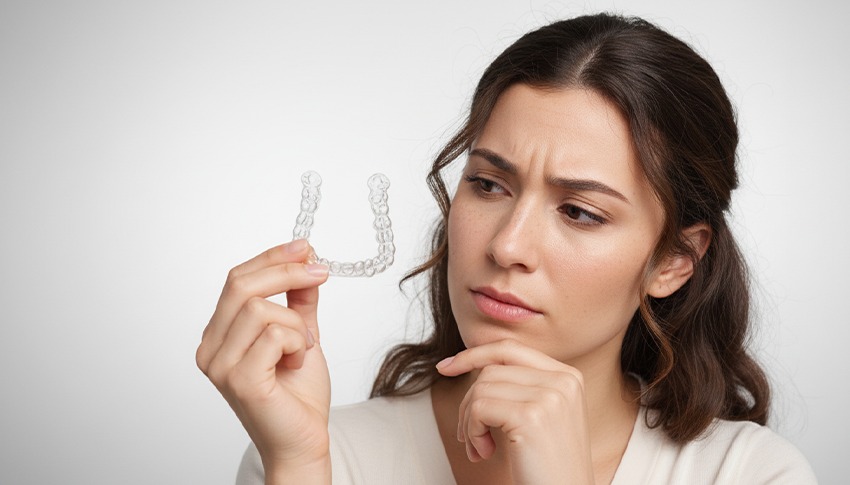
Clear aligners have transformed orthodontic treatment, offering a nearly unnoticeable alternative to traditional metal braces. However, despite their growing popularity, numerous misconceptions linger about this modern orthodontic method. But don’t worry, we’re here to help.
Read this guide to bust common misconceptions about clear aligners.
Myth: Only Small Dental Problems Can Be Solved with Clear Aligners
Many individuals believe transparent aligners can only repair slightly crooked teeth or minor spacing issues. However, developments in aligner technology have substantially improved their capabilities. A variety of orthodontic problems can be successfully treated with today’s clear aligners, including crowding that is moderate to extreme, issues with spacing, underbites, and overbites, etc. Clear aligners can deal with many of the same problems as metal braces, frequently with similar outcomes, while there are still some complicated instances that might benefit from traditional braces.
Myth: Clear Aligners Are More Expensive
Cost is commonly highlighted as a key downside of clear aligner treatment. Although certain high-end clear aligner brands can cost more than conventional braces, the general cost gap has considerably decreased. The final cost is influenced by numerous factors:
- Clear aligners are currently covered by many dental insurance policies at the same cost as conventional braces.
- For both treatment choices, dental offices frequently provide comparable payment arrangements.
- More reasonably priced solutions have been made possible by direct-to-consumer aligner possibilities (albeit these come with key problems surrounding oversight).
Unlike braces, clear aligners do not have “hidden costs”, including more regular office visits and even emergency appointments for damaged brackets or wires.
Myth: Clear Aligners Take More Time Than Braces
Some individuals believe that clear aligners must take longer to produce results because they seem less solid than metal braces. However, that’s not true; the usual duration of treatment with clear aligners is between 12 and 18 months, which is equivalent to that of traditional braces. In certain situations, clear aligner treatment may actually be quicker, especially for little adjustments. The primary parameters impacting therapy time include:
- The complexity of your dental problems
- Your adherence to using aligners for the suggested 20–22 hours every day
- Following your orthodontist’s instructions
Myth: Clear Aligners Are Merely Cosmetic Fix
Clear aligners are dismissed by some as merely a cosmetic substitute for “real” orthodontic treatment. However, just like traditional braces, clear aligners are legal orthodontic devices that shift teeth by precisely calculated force applications. Properly aligned teeth have benefits beyond aesthetics: improved bite function, decreased chance of irregular tooth wear, and relief from jaw pain for some patients with biting difficulties.
Myth: Clear Aligners Are Uncomfortable
Some people are concerned that transparent aligners may be difficult to use or require a lot of upkeep. The truth is that most patients say transparent aligners are more pleasant than traditional braces, even if every orthodontic treatment entails some discomfort, especially when starting a new aligner set. Unlike metal braces with visible brackets and wires that may hurt cheeks and gums, clear aligners have soft edges.
Not just that, but clear aligners are also easy to maintain:
- Clear aligners are detachable, making dental hygiene simpler, just brush and floss regularly.
- Cleaning aligners is easy and can be done with a soft toothbrush or special cleaning solutions.
- There are no food limitations as aligners are removed when eating.
Myth: Clear Aligners Are Suitable for Adults
Many people believe that individuals who wish to avoid the appearance of metal braces are the only ones who can use transparent aligners. The truth is that many kids are great candidates for clear aligners, even if adults do make up a sizable number of these patients. Special teen aligner items commonly include:
- Indicators of compliance to guarantee appropriate wear time
- Eruption tabs to accommodate developing molars and expanding jaws
- Replacement aligners for misplaced or damaged sets
Clear aligners can be a great option for responsible teenagers who can make the commitment to wear them regularly.
Myth: Clear Aligners Are Pain-Free
Clear aligners are renowned for being more comfortable than metal braces. However, they are not fully pain-free. Like any orthodontic treatment, transparent aligners shift teeth by applying pressure, which can cause slight discomfort, particularly when moving to a new set of aligners. As the teeth get used to the new pressure, this feeling usually lasts for a few days.
The good news is that:
- The most common description of aligner discomfort is pressure rather than severe pain.
- Patients frequently report less sensitivity to the gums and cheeks compared to traditional braces, as there are no metal brackets or wires.
- During the adjustment period, any discomfort can be managed with over-the-counter painkillers.