
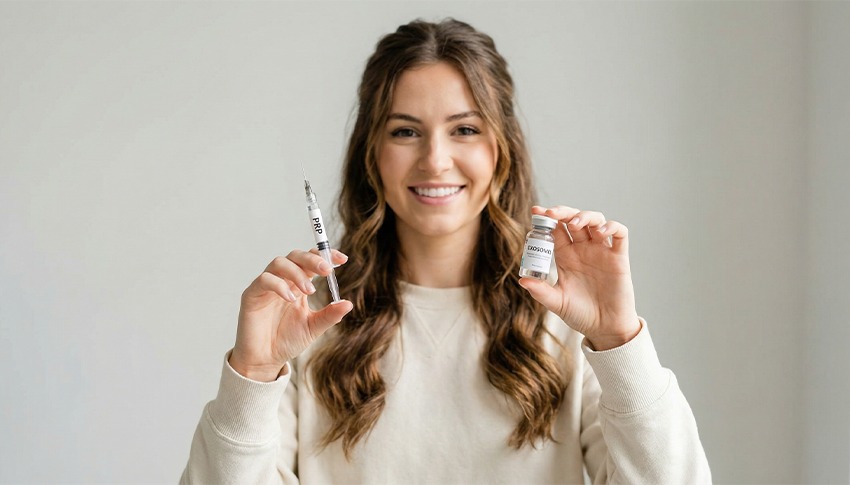
Have you started noticing receding hairlines, thinning hair, or bald patches? Well, you’re not alone! Hair thinning and hair loss are one of the most common problems amongst women and men. Fortunately, modern regenerative treatments such as hair PRP treatment and exosome therapy have made it easier than ever to get healthier and stronger hair growth by healing your scalp! Both treatments stimulate hair growth and restore volume, resulting in stronger and healthier hair growth. But which treatment is more effective? Read this guide to find out.
What is Hair PRP Treatment?
Hair PRP therapy uses the patient’s own platelet-rich plasma to restore hair and rejuvenate the face. Growth factors found in these blood platelets aid in the healing of bodily tissue, including hair follicles, and encourage the creation of more hair. In order to stop hair loss and fortify hair follicles for thicker growth, platelet-rich plasma is injected into the scalp.
What is Exosomes Therapy?
A patented method is employed to separate and purify exosomes from donated human amniotic mesenchymal stem cells for use in exosome hair loss treatment. Stem cell exosomes are used in exosome hair loss therapy, a regenerative treatment, to stimulate hair follicles and promote the creation of new hair. Exosomes are injected into the damaged areas of the scalp in this state-of-the-art technique to promote hair growth. They carry signals to start cell activities and directions for cell regeneration.
For hair regeneration, exosome treatment usually entails:
- Application: Microneedling exosomes into the scalp
- Action on Hair Follicles: By enhancing cell communication and fostering a regenerative environment, exosomes, once delivered, promote the activation and development of hair follicles.
What Happens During Hair PRP Therapy?
- A thorough explanation of the process precedes the treatment. This shows that the patient is aware of the procedure’s dangers, advantages, restrictions, and available options.
- After that, a certain amount of blood will be drawn; the precise amount will depend on the office’s system. The patient will often be transferred to a treatment room while the PRP is being made, and if necessary, a local anesthetic will be given.
- The blood sample will be transported to test tubes or separation containers after being processed in accordance with the system-specific protocol, which may entail a single or double spin. Packed red blood cells, platelet-poor plasma (PPP), and platelet-rich plasma are the final products.
- The PRP will be injected into the scalp using microneedling. If this is the case, nitrous oxide gas or an anesthetic ring block may be used to lessen any discomfort. The process will last for 20-40 minutes.
Differences Between Exosomes Therapy and Hair PRP Treatment
Although the goal of both treatments is similar, hair rejuvenation, their methods, efficacy, and overall experiences differ.
Origin of Healing Elements
- Hair PRP makes use of growth factors and platelets from your body.
- Exosomes are lab-engineered particles made from stem cells that carry more sophisticated regeneration signals.
Action Mechanism
- PRP: Uses your body’s own platelets’ inherent healing qualities to stimulate hair follicles.
- Exosomes: Promote stronger hair regrowth by directly improving cellular communication and repair.
Length of Results
- PRP: To see effects, it frequently takes several treatments over a longer time frame. Every few months, maintenance sessions can be required.
- Exosomes: May require fewer treatments and produce outcomes more quickly and dramatically. As hair growth cycles continue, results can get better over several months.
Treatment Frequency
- PRP: Usually calls for three to six treatments spaced four to six weeks apart, followed by maintenance treatments every six to twelve months.
- Exosomes: Because of their high efficacy, fewer treatments—typically one or two sessions—may be needed.
Downtime and Recovery
- PRP: Slight swelling or discomfort at the injection site with little recovery time.
- Exosomes: They have a similar healing period and may cause some little redness or swelling, although they are frequently said to recover even faster than PRP.
Strength and Efficiency
- Natural growth factors are included in PRP, but their quantity and kind are restricted to what is present in your blood.
- Exosomes therapy may be possibly more effective than PRP, as they provide a concentrated, potent combination of growth hormones, cytokines, and proteins tailored for regeneration.
Thus, both exosome therapy and hair PRP treatment are excellent choices for hair rejuvenation. However, the severity of hair loss, desire for results, individual preferences, and budget will determine which treatment is more suitable for you. You can visit Hash Invasive to consult the expert doctors and find out which treatment will suit your needs best.