
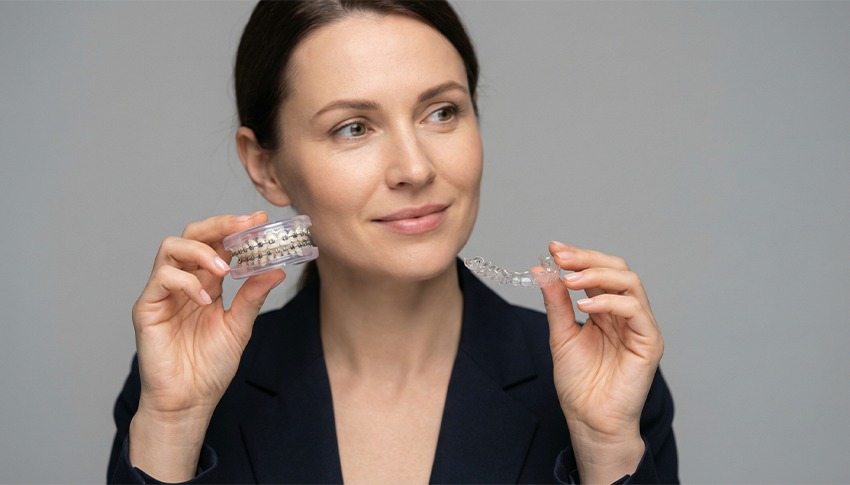
Thanks to new technology and advancements, there are more options than ever in modern dentistry when it comes to straightening your teeth. Metal braces were the accepted orthodontic treatment for many years, but these days, invisible braces, sometimes referred to as clear aligners, are a common substitute, particularly among adults and teenagers seeking a more discreet choice. Although both options are efficient, they differ in terms of cost, look, comfort, durability, and upkeep. So, which one is the better option for you? Let’s find out.
What Are Metal Braces and Invisible Braces?
The traditional orthodontic system, consisting of metal brackets and wires, is called a brace. They are affixed to the teeth and use regulated pressure to gradually move them into correct alignment. Metal braces are robust, long-lasting, and successful in correcting a wide range of dental conditions, from slight misalignment to serious overcrowding or bite difficulties. They continue to be one of the most popular orthodontic procedures due to their strength and adaptability.
Invisible braces, sometimes referred to as clear aligners, function similarly to conventional braces but substitute translucent or tooth-colored ceramic brackets for metal ones. As a result, they are far less noticeable, creating the illusion of a more covert procedure. They are a popular option among adults and teenagers because they provide the same orthodontic benefits but can be more aesthetically pleasing.
Here are some factors to consider when deciding between metal braces and invisible braces.
Aesthetics and Appearance
The appearance of invisible and traditional braces is one of their main distinctions. Stainless steel brackets and wires, which are highly noticeable, are used in traditional braces. Even while modern metal braces are more sophisticated and smaller than their enormous predecessors, they nevertheless make a statement when you smile. Some people don’t like the appearance and even like using colorful bands to personalize their braces.
Conversely, invisible braces are made to look more like natural teeth. These brackets are much less noticeable from a distance because they are made of tooth-colored ceramic. To further decrease visibility, the wires may be frosted or lighter in color. Thus, they are particularly well-liked by grownups and anyone looking for a covert treatment option.
Discomfort and Irritation
Although comfort varies from individual to individual, the sharper brackets of traditional metal braces can often irritate the lips and cheeks more. Although the first discomfort may be more noticeable, most people eventually adapt and stop noticing the friction.
Smoother and marginally more comfortable on the delicate tissues of the mouth are common descriptions of invisible braces. The ceramic material seems to give less irritation despite the wider brackets. A lot of patients say that their mouths adjust faster.
When the wires are tightened, both kinds of braces may cause momentary discomfort, but this is a natural aspect of the alignment procedure and usually goes away in a few days.
Durability and Strength
Conventional metal braces are seen to be the most robust choice. Metal is durable, resilient, and unlikely to chip or shatter. Because of their endurance, metal braces are a dependable option for individuals who require considerable orthodontic modifications, such as those with severe overcrowding, large gaps, or serious bite problems like overbites and underbites.
Despite their strength, invisible braces are a little more brittle due to their ceramic construction. Patients who participate in high-contact sports shouldn’t use the brackets unless they are wearing protective gear, since they can chip if subjected to severe force. Additionally, ceramic brackets may feel more obvious in the mouth because they are slightly larger than metal ones.
Efficiency in All Dental Problems
Every kind of orthodontic condition, from straightforward misalignment to intricate jaw problems, can be resolved with traditional metal braces. Orthodontists frequently suggest metal braces for situations requiring substantial movement or intricate adjustments due to their strength and flexibility.
Although invisible braces are equally effective, orthodontists might not apply as much strain or tension since ceramic brackets are more delicate. Because of this, invisible braces are a little less appropriate for complex problems. Nonetheless, they are highly effective for people who emphasize aesthetics during treatment and for mild to moderate misalignment.
So, the decision between invisible braces and metal braces ultimately boils down to your own requirements, tastes, and objectives. Invisible braces offer a discreet, comfortable solution that many adults and teenagers find appealing, but metal braces are still a dependable and efficient option for more complex dental issues!