
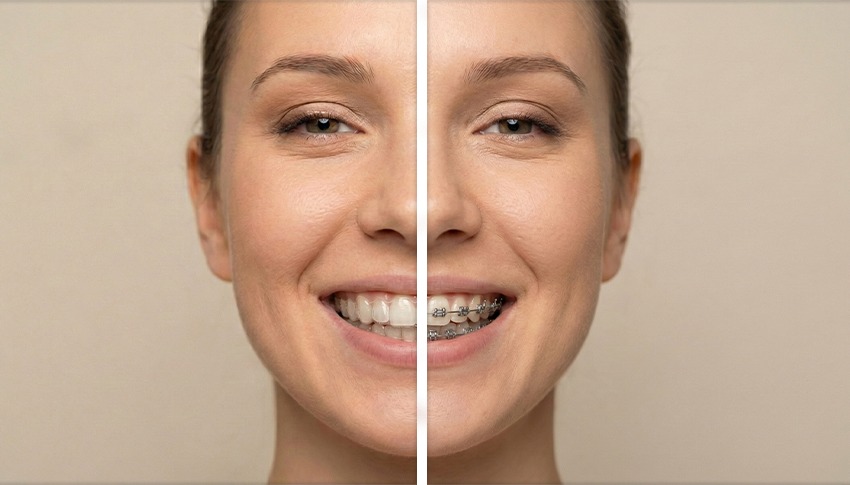
Over time, orthodontic procedures have changed dramatically, giving patients additional choices for a straight, attractive smile. Clear braces and clear aligners are two of the most widely used options. Although they both work well for straightening teeth, they are not the same and have unique characteristics that may make one better for you than the other. In order to assist you in determining which option could be ideal for your orthodontic needs, we’ve outlined a guide that compares and contrasts the features of each option.
Continue reading to learn more about clear braces and clear aligners.
What Are Clear Aligners?
Custom-made clear plastic trays that fit snugly over the teeth make up clear aligners like Invisalign. To progressively reposition the teeth into the ideal position, these detachable trays are changed every one to two weeks. Because they are almost undetectable, clear aligners are a very attractive orthodontic treatment option. Because there are no metal brackets or wires to irritate the mouth, they are also more comfortable than traditional braces.
What Are Clear Braces?
Although they are made to be less obvious, clear braces work similarly to conventional metal braces. They are a more attractive choice for people who are worried about how metal braces look since they employ ceramic brackets that match the color of your teeth. To improve the discreet appearance, the wires connecting the brackets might be tooth-colored. As fixed appliances, these braces are affixed to your teeth and can only be removed by an orthodontist. They gradually move the teeth into the appropriate position by continuously applying pressure to them. Periodically, adjustments are needed to make sure the teeth are moving properly.
Common Differences Between Clear Braces and Clear Aligners
Here are some common differences between clear aligners and clear braces.
Convenience and Comfort
In general, clear aligners are more comfortable than clear braces. Unlike braces’ brackets and wires, which can cause pain and blisters, the smooth plastic trays do not irritate the gums or the inside of the mouth. Convenience is further enhanced by the option to take off aligners for oral hygiene, eating, and drinking.
Clear braces do not require patient cooperation with regard to wear time because they are fixed items. However, because food particles might become stuck around the brackets and wires, they can make eating and maintaining good dental hygiene more difficult.
Visual Appeal
Compared to conventional metal braces, clear braces and clear aligners both have visual benefits. While clear aligners are composed of nearly undetectable translucent plastic, clear braces use ceramic brackets that blend in with the teeth. However, because they are less obvious than even clear braces, clear aligners usually provide a better degree of discretion.
Efficiency
A variety of orthodontic problems can be successfully treated with both clear braces and clear aligners. On the other hand, difficult cases needing substantial tooth movement or rotation may be better suited for clear braces. For patients who have enough discipline to wear them as prescribed, clear aligners are perfect for mild to moderate orthodontic problems.
Upkeep and Hygiene
In terms of dental hygiene, clear aligners are simpler to maintain. They can be taken out so that patients can brush and floss their teeth more completely. Conversely, in order to avoid plaque accumulation and discoloration, clear braces need more thorough cleaning around the brackets and wires.
Frequent Modifications
For adjustments, clear braces need to be seen by the orthodontist on a regular basis, usually every four to eight weeks. The orthodontist will tighten the wires and adjust the brackets as needed during these appointments. Because patients typically receive multiple sets of aligners at once and replace them at home every one to two weeks, clear aligners require fewer office visits.
Duration of Treatment
Depending on how complicated the case is, the length of treatment for both transparent braces and clear aligners varies. Both therapies often take a few months to several years. However, because clear aligners can shift teeth more effectively when worn regularly, they may provide faster treatment timeframes for milder instances.
Which Option is Better for You?
The nature of your orthodontic needs, your lifestyle, and your personal preferences all play a role in the decision between transparent braces and clear aligners. To find the best solution for you, speaking with a skilled orthodontist is essential. Clear braces might be a better option if you want a fixed appliance that requires less daily discipline. They have the aesthetic benefit of being less apparent than metal braces and are useful for a variety of orthodontic problems. However, clear aligners can be the best choice if you value comfort, secrecy, and being able to take off your orthodontic appliance. They are especially appropriate for patients with mild to moderate orthodontic problems and those who are able to wear them for the prescribed number of hours per day.