
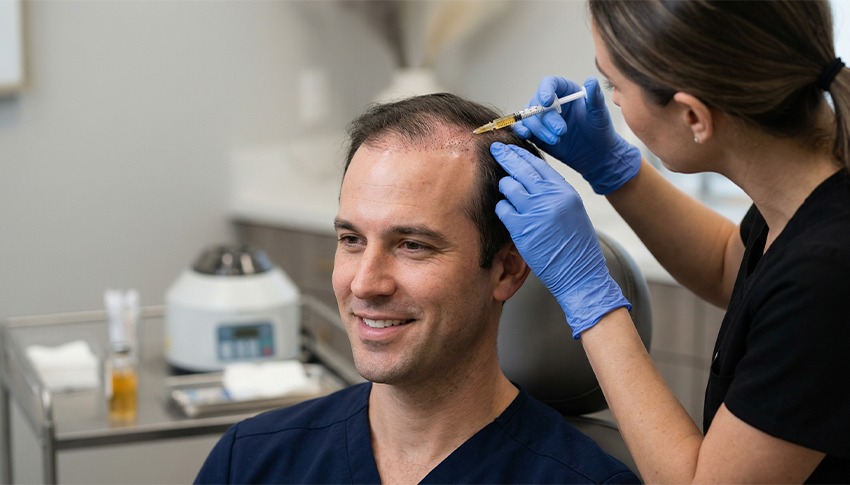
Are you confused about getting hair PRP treatment? Indeed, hair PRP treatment has transformed the field of hair restoration by offering a natural and effective method to combat hair loss and hair thinning. However, uncertainty around recovery and the healing period may make you feel confused and hesitant about getting a hair PRP treatment. But don’t worry, we’re here to help.
Here’s what you need to know about pre- and post-treatment care to ensure safe and smooth recovery after hair PRP treatment.
What is Hair PRP Treatment?
The cutting-edge, non-surgical Platelet-Rich Plasma (PRP) hair treatment stimulates hair growth and increases hair density by utilizing your body’s natural healing processes. A little amount of your own blood is drawn, processed to concentrate the platelets, and then the concentrated plasma is injected straight into your scalp as part of the treatment. In order to encourage your hair follicles to enter the active development phase and produce stronger, thicker hair strands, Hair PRP treatment delivers a concentrated dose of growth factors and proteins directly to your hair follicles. In essence, this procedure gives weak or dormant hair follicles the biological cues they require to start producing healthy hair again.
Pre-Treatment Care
Here’s what you need to do at least seven days before the treatment.
- Stop taking multivitamins and blood thinners such as vitamin E, vitamin A, cod liver oil, and essential fatty acids for a minimum of 7 days (ideally 14 days) before beginning treatment. Iron and vitamin D can be continued without any problems.
- Before the procedure, you can take Tylenol (acetaminophen) as needed.
- Up until and including the day of your treatments, you should take prescription drugs (such as blood pressure and heart medicine) as directed.
- Please let your doctor know if you are taking wide beta-blockers like Inderal (Propranolol), since this medication may need to be switched to a select beta-blocker before starting therapy.
- Steer clear of too much heat or sun exposure.
- Please notify your doctor right away if you are using any blood thinners, as this treatment may not be appropriate for you. Heparin, Coumadin, and Plavix are some of these drugs.
- Steer clear of anti-inflammatory drugs such as aspirin, Advil, Motrin, Ibuprofen, Naproxen, etc.
Here’s what you need to do at least three days before hair PRP treatment.
- Reduce or stay away from alcohol.
- Smoking affects the healing process, so try not to smoke before your treatment.
- Prior to hair PRP treatment, you could continue using hormone-blocking medications, minoxidil, or laser treatment for hair loss. Please inquire if you are unsure if you should stop taking a drug.
- To make the blood draw easier, increase your fluid intake the day before your procedure by simply consuming two glasses of water in the morning, two glasses at lunch, and two glasses in the evening.
Day of Treatment
- On the morning of hair PRP treatment, take a shower and use your usual shampoo to thoroughly cleanse your hair.
- Sprays, gels, and other styling products should not be used on your hair.
- Please take off your hair systems before shampooing and avoid wearing them before PRP treatments.
- On the day of your hair PRP treatment, please have a typical breakfast or lunch.
- To facilitate the blood draw, consume a 500 mL bottle of water at least two hours prior to your appointment.
- To maximize the benefits of PRP, it is highly advised to wash your hair in a hot shower that evening following the procedure.
Post Treatment Care
- After your treatment, bruising, redness, itching, swelling, and/or pain are common and may persist for two to five days. You can use Tylenol or other acetaminophen-containing medicines as prescribed if you feel any pain or discomfort.
- For at least two days following your treatment, stay out of the sun, heat, and strenuous exertion.
- There can be a bruise where the blood was drawn.
- When the cells are activating, you could get a tingling feeling.
- Use pH-balanced shampoo for the first three days.
- Rarely, there may be a skin reaction or infection that can be readily treated with an antibiotic or an anti-inflammatory medication. However, if you experience any odd discomfort, please get in touch with your doctor right away.
- Since ice has anti-inflammatory properties, try not to apply it to the injected location. If necessary, ice or cold compresses can be used to lessen swelling.
- After hair PRP treatment, wait at least six hours before using any hair products.
- To maximize the results of PRP, make sure to shampoo your hair and take a hot shower that night after the procedure.
- For two days following your treatment, stay away from steam rooms, saunas, and swimming pools.