
Keeping the spaces between your teeth clean is an important part of maintaining good oral health. Brushing can clean between the surfaces of your teeth, but not all areas. That’s where interdental cleaning comes in. Traditional dental floss has been recommended for decades, while water flossers have become increasingly popular as a convenient alternative. Both of them can be effective at getting rid of plaque and food particles in areas a toothbrush can’t reach, but they do so differently and might be appropriate for different people. So, which is better for your teeth? The answer will be based on your oral health, dexterity, preferences, and consistency of use. Understanding the advantages and limitations of each option can help you choose an interdental cleaning routine that you can maintain every day.
Read this guide to learn more about flossing and water flossing.
How Does Traditional Flossing Work?
Traditional dental floss is a thin string that physically removes plaque between the sides of teeth and just below the gum line. Floss can get rid of trapped foods and plaque where a toothbrush can’t reach, when you use it right. The floss should be pushed between the teeth and bend around each tooth and not just pushed up and down to clean. The technique is important because the floss may sting or irritate the gums if it is snapped against them. One advantage of traditional floss is that it is inexpensive, portable, and doesn’t require batteries, electricity, or a device. It can also be particularly useful when teeth have relatively tight spaces between them. However, some people may find flossing challenging, particularly if they have limited hand dexterity, braces, bridges, or other dental work.
What Is Water Flossing?
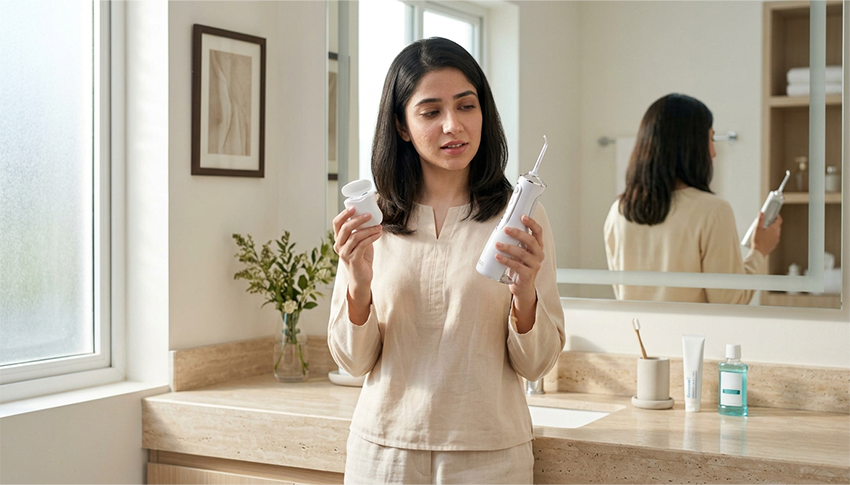
An oral irrigator, or “water flosser” works by pulsating water to clean around and between the teeth and along the gum line. Water stream helps to flush food debris away and break up plaque in hard-to-reach places, rather than physically pushing material between teeth. Water flossers come in various styles such as countertop and portable types and are becoming popular for home oral hygiene. They can be particularly convenient for people who find traditional floss difficult to handle. Water flossers can also be helpful with braces, bridges, crowns, implants and other dental appliances where extra cleaning may be necessary. Using a water flosser does, however, require the correct technique. This must be used in accordance with the manufacturer’s recommendations, the pressure that’s accurate for you, and the tip that’s suitable for you.
Which Is Better for Removing Plaque?
Both traditional floss and water flossers can contribute to effective interdental cleaning, but their effectiveness can depend heavily on how they are used. When used properly, traditional floss will contact the side of each tooth directly, so that you clean effectively between the sides of each tooth. Water flossers, on the other hand, can help dislodge food particles and debris from regions that may be hard to reach. Research has found that water flossers can be effective at reducing plaque and improving gum health when used as part of a regular oral-hygiene routine. However, individual results vary. Discuss it with your dentist to decide which one is right for your mouth.
What’s the Best Option for Gums?
Normal, healthy gums should not bleed during normal cleaning. However, sometimes, when people first start flossing their gums bleed, which may be due to plaque accumulation and gum inflammation, but may also be something more than that. Using the traditional floss gently can clean around the gumline as well. Similarly, a water flosser may be a good choice for those with sensitive gums or those who do not like traditional floss. Being able to adapt the pressure of the water can also make the experience easier. However, water flossing isn’t a substitute for professional dental care if you have ongoing gum problems. Bad breath, persistent bleeding, swelling, tenderness, recession or swelling can be indicators you need a dental evaluation. Your dentist will be able to identify if there is a problem with your gums, periodontal disease, technique or something else.
Which Option is Easier to Use Every day?
Convenience can make a major difference in whether you maintain an oral-hygiene habit. Floss is inexpensive, small and easy to carry, and is convenient when traveling or using outside the home. Some, however, have difficulty maneuvering it the right way, especially when they have little hand-eye coordination or very close teeth. Water flossers must be charged or plugged in and need access to water and a power source (or charged battery, depending on the model). However, some people find that it becomes more manageable and comfortable once they get used to it. If you’re more likely to use a water flosser consistently than traditional floss, it may be the better practical choice for you. In short, remember that the most effective interdental cleaner is the one that can easily fit into your daily routine.