
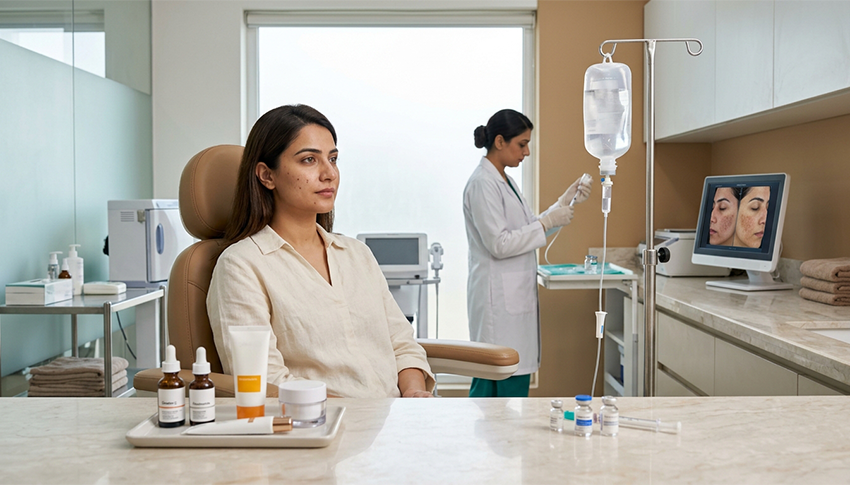
When it comes to skin brightening, there are many different products available, and it can be difficult to know which ones will actually work. Two treatments that are commonly mentioned are whitening injections and topical whitening products. However, they’re not the same. They vary in their mode of administration, what they are designed to treat, how quickly results might become evident and what risks should be considered. So, which one is more effective in 2026?
A suitable treatment should be based on an individual’s skin concerns rather than unrealistic expectations about dramatically altering their complexion. Not just that, but it is especially vital to have professional assessment before you think about using an injectable treatment since the ingredients, and the safety of the product may differ. Knowing about these differences can help you decide which one to use.
Read this guide to learn more about the differences and effectiveness of whitening injections and topical treatments.
How Do Topical Skin Brightening Treatments Work?
Topical treatments are products that are applied directly to the skin. Their formulations can include active ingredients that help to fade pigmentation, promote skin renewal or enhance brightness. The most popular active ingredients in anti-pigmentation skincare products include prescription formulas, vitamin C, niacinamide, retinols, etc. Topicals act on the surface and on the upper layers of the skin with effects typically taking time to become apparent with regular use. However, keep in mind that combination products with more than one active ingredient is not necessarily more effective, and can irritate sensitive skin, potentially causing an increase in pigmentation. A dermatologist or qualified skin specialist can help determine the right skincare regimen for your skin type with the right topical products to get a more even skin tone.
What Are Whitening Injections?
Skin whitening injections are IV (intravenous) treatments which contain a high concentration of skin-brightening and antioxidant ingredients that are administered into the blood stream. The most crucial ingredient is glutathione which is a potent antioxidant found within the body naturally, and crucial in controlling skin pigmentation. These whitening injections straight enter the bloodstream without getting digested. This means that the entire dose will get to the cells without any loss of potency. When seeking any cosmetic treatment using an injected product like whitening injections, consult a trained medical professional to learn about the product itself, its ingredients, risks, potential benefits, and the evidence behind its claims.
How Are the Treatments Delivered?
The most obvious difference between the two approaches is the method of administration. Topical treatments are applied externally to the skin, and injections are given into the body. The difference is important because a substance injected into the body is acted upon differently than a substance rubbed on the skin. Irritation can be prevented with a topical product, but some topical ingredients may lead to serious reactions if not used properly. If an injectable treatment is administered, it cannot be easily removed. This may be one of the reasons why cosmetic injections are also taken more seriously than buying a cosmetic skin care product.
Thus, during a consultation, your medical history, allergies, medications, the exact substance you’re receiving, and whether or not it’s suitable for you will all be discussed. Treatment method should always be determined by the particular concern being treated instead of assuming that the more potent or the quicker the treatment will be more effective.
Which Option is Better for Pigmentation?
Both methods are not direct solutions for pigmentation problems since pigmentation can have many causes. For instance, acne and inflammation can leave behind dark spots and hormones and UV exposure can cause melasma. A dermatologist’s initial treatment for many common pigmentation issues will involve protection against the sun and an appropriate topical treatment on a daily basis. Depending on the diagnosis, other professional treatments may be recommended.
However, treatment for pigmentation is not the same as skin whitening, thus, whitening injections cannot be a cure for pigmentation completely. This means that until underlying cause isn’t identified, simply trying to lighten the skin may not address the actual problem. The first step should therefore be determining why the pigmentation is occurring. Understanding the cause allows a skin specialist to suggest a method that can treat that particular concern.
Which Treatment Should You Pick?
It depends on the skin concern you want to address, rather than just whether you are looking for a brighter complexion. For mild uneven skin tone or pigmentation, a topical regimen could be a good first step. If a concern is continuing, widespread and not easily identifiable, whitening injections may be a good option after professional skin evaluation.