
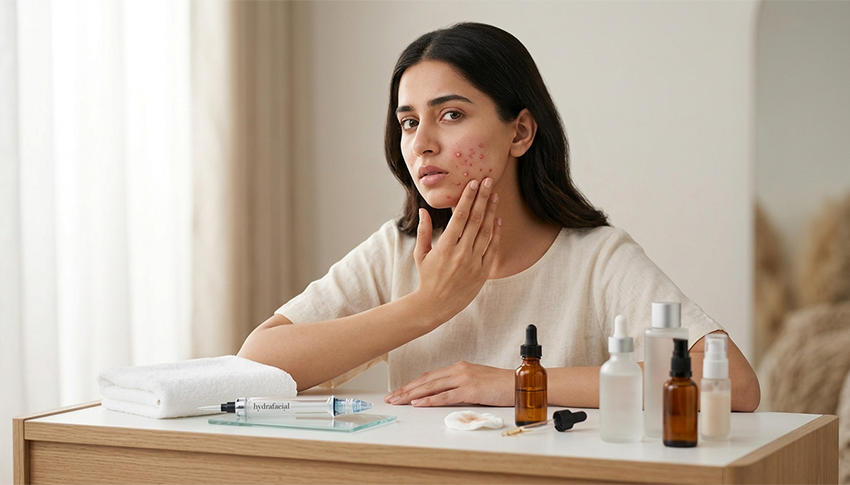
Did you just undergo HydraFacial? You may anticipate that your skin will look cleaner, brighter and smoother. But what if you observe acne breakouts instead? You may be left confused and puzzled! Remember, mild acne appearing after a HydraFacial treatment does not necessarily mean that something went wrong. Your skin may be reacting to the treatment temporarily or skincare product you were using earlier. But there is no need to consider every blemish as “purging” of the skin. Instead, it is a good idea to know why your skin is breaking out and what is considered to be reasonable regularity. It will help you build a proper skincare routine instead of overloading your skin with additional products or treatments.
Read this guide to find out common reasons why your skin may breakout after HydraFacial.
Reaction to Exfoliation
One common reason why you may notice small bumps is the exfoliation phase in the treatment. Hydra Facial exfoliates and clears away buildup and dead skin cells, which may alter the look and feel of your skin for a brief period. However, if the pores are already clogged, introducing the dirt to the surface could make it more visible soon after treatment. This is referred to the “purging” phase sometimes, but not all post-treatment breakouts are actually purging. It’s possible you will see small bumps, whiteheads, or congestion that did not appear before you came in for your appointment. However, these changes will typically fade as your skin adapts. If the appearance of bumps becomes more painful, itchy, swollen or widespread, however, do not consider it as a normal part of the process; contact your skincare professional for an assessment.
Sensitivity to a HydraFacial Ingredient
HydraFacial treatments can be customized using different serums and ingredients depending on the patient’s skin concerns. These products are typically chosen based on the treatment, but certain ingredients can interact differently with every individual’s skin. Some people with sensitive or reactive skin might experience redness, bumps, itching or irritation when a new product or active ingredient is used. That doesn’t always mean the ingredient is “bad” for the skin, but it could mean it is not right for you at that concentration or when combined with your current skincare routine. Therefore, if there is a reaction following treatment, inform your dermatologist about the products used. It can also be helpful to keep a record of what ingredients trigger and what makes your skin feel better so you can tweak future treatments accordingly.
Extractions Can Irritate Your Skin
Another possible reason for post-HydraFacial breakouts is the extraction process. A major part of the treatment is removing oil, debris and congestion from pores. Extraction may help clear the skin but can also irritate it and cause temporary redness, especially if it is already sensitive or congested. Squeezing, touching or picking at the areas treated can also aggravate the irritation and cause infection. Your skin may also be more sensitive right after to the treatment as it has just been cleansed, exfoliated and extracted. Thus, giving it time to recover is important. Try not to touch bumps and stick with the aftercare steps suggested by your practitioner instead of attempting to aggressively treat the acne yourself.
Harsh Skincare Products Post HydraFacial
A common mistake following a HydraFacial is resuming a high-strength skincare regimen. After exfoliation and extraction, your skin might feel smooth and new, but at the same time, it could be more sensitive. All retinoids, exfoliating acids, scrubs, benzoyl peroxide and other strong active ingredients used immediately after the treatment can cause irritation and may lead to bumps or redness. Therefore, follow the aftercare instructions provided by your skincare professional. During the first recovery phase, a simple regimen of using mild cleanser, moisturizer and sun protection may be more suitable. After the skin has calmed down, you can slowly start using your regular active products with your dermatologist’s advice. Giving your skin a little break can help to avoid unnecessary irritation and help preserve the results of your treatment.