
Have you gotten your skincare routine all figured out? You wash, you put moisturizer on, you put sunscreen on and sometimes you even get a facial. But some mornings, your skin looks dull, uneven or just not the way you want it to look. This is usually when the idea of a professional brightening treatment comes in.
With so many options–brightening facials, chemical peels, laser treatments, whitening injections it can be confusing to know what your skin actually needs. Social media makes that decision even more difficult, with before and after photos promising dramatic transformations. Nonetheless, not all uneven skin tones require professional assistance, and not all skin brightening treatments provide the same results.
So, how do you determine whether it is worthwhile to consider such treatments or whether your current routine will work?
What Does Skin Brightening Actually Mean?
Usually, skin brightening is misinterpreted as the process of lightening the skin’s natural color. In truth, most skin brightening treatments aim to tackle uneven skin tone, minimize dark spots or combat dullness. For instance, an individual has acne scars and seeks to achieve an even skin tone, while someone with pigmentation from sun exposure seeks to reduce the visibility of discoloration. The skin issues are different, and thus the solutions to them also vary from one another. The color of the skin is primarily determined by genetics and the production of melanin.
Therefore, having dull skin does not equate to having unhealthy skin and needing a brightening treatment. The goal of an adequate treatment should be to eliminate the problem that needs to be addressed rather than simply changing the skin tone for the sake of the perceived beauty of light skin.
Is Your Skin Looking Dull Despite a Consistent Routine?
Regardless of how meticulously you take care of it, the skin may occasionally appear dull. Some of the causes of dull skin may include dryness, buildup of dead skin cells, exposure to the elements, and inflamed skin. This may contribute to the dullness of the skin but does not necessarily mean that there is a serious dermatological issue.
Before seeking treatment, try to analyze your everyday movements. Are you applying moisturizer daily? Are you wearing sunscreen? Have you started using multiple active substances in your routine?
In case dryness is the problem, an updated skin routine may do more to improve the situation than a new treatment. In the case of stubborn dullness, the dermatologist may offer a treatment that will help in the case of the condition in question.
Are Dark Spots Taking Longer to Fade?
The emergence of dark spots on the surface of the skin is one of the main reasons people are looking for skin-lightening remedies. Dark spots can be formed after acne, inflammation, insect bites, or other skin traumas. This process is known as post-inflammatory hyperpigmentation. The difference between such spots and active pimples is that the spots will remain for weeks and months. Some spots gradually disappear with time, particularly when combined with appropriate skin care and proper protection from the sun. Other spots need treatment.
Depending on the type of skin and cause of pigmentation, dermatologist will recommend the use of certain topical ingredients or chemical peels. The most important thing is to know the cause of the problem before choosing the way of treatment. Choosing a wrong method of treatment can provoke irritation of the skin which can worsen pigmentation.
When Might a Professional Brightening Treatment Help?
If you have a specific issue that hasn’t responded to proper home care, it may be advisable to consider professional treatment. Stubborn post-acne marks, some forms of pigmentation caused by sun exposure, or skin tone irregularities can benefit from treatments designed best for you. Certain chemical peels may help to diminish mild pigmentation, and precise laser treatments may be employed for specific problems.
However, the outcome will depend on the diagnosis, skin type, selected treatment, and skin reaction to the treatment. Professional treatment can also be limited in its effectiveness and have side effects such as skin irritation and post-inflammatory hyperpigmentation. The dermatologist will offer you a proper understanding of what improvement you can anticipate and how long it may take to see the effect.
How Do You Know Which Treatment Is Right for You?
The appropriate solution varies based on the skin problem that you are facing. Two people may report their skin being shiny, yet one might be dealing with dehydration while the other one is showing signs of pigmentation. In the same respect, even a treatment recommended for one skin type may result in skin irritation or pigmentation for someone else.
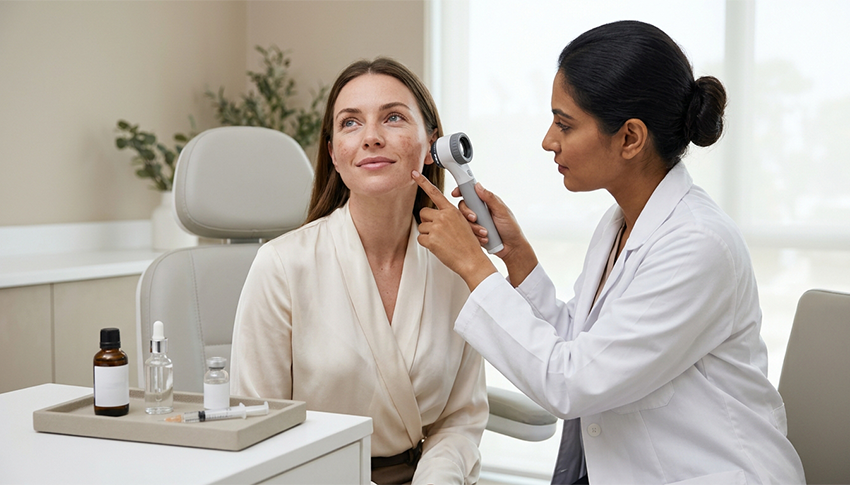
Ideally, the consultation should include examining the skin as well as talking about your skincare routine. Moreover, it is advisable to inquire about side effects, recovery, costs, and need for assistance in the future. Do not choose a procedure only because it is in vogue or because another person obtained great results with it. Your treatment plan should focus on the needs of your skin but not on someone else’s experience.