
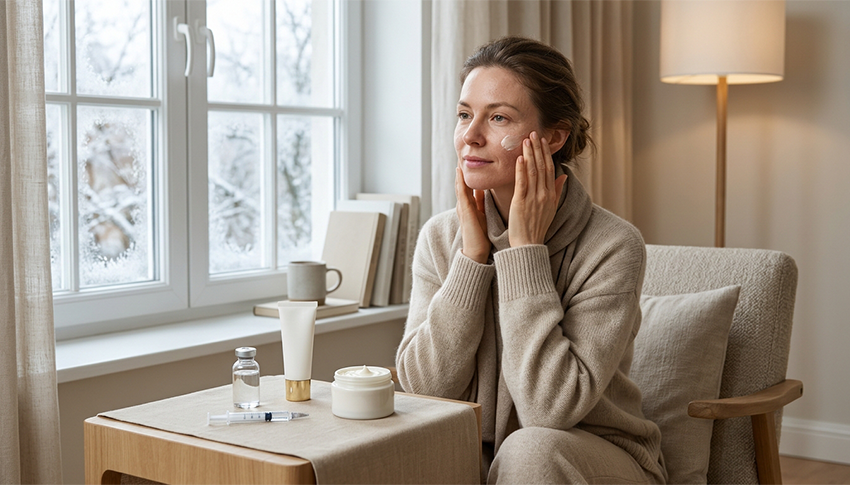
Indeed, your skincare needs may also shift as the weather cools down. Products that functioned perfectly well in summer suddenly seem not enough and dryness, rough patches and uneven looking skin are more obvious.
Winter can also affect how people think about cosmetic treatment. Others get more interested in hydration treatments, skin-brightening products and professional treatments as they prepare for the months ahead.
But changing your skincare routine isn’t simply a case of slathering on a heavier moisturizer. Knowing what happens to your skin in colder weather will allow you to make better choices about the products and treatments you select.
Read this guide to learn more winter skincare routine.
Why Does Your Skin Feel Drier?
One of the first changes people notice during winter is increased dryness. Moisture loss can be caused by cooler temperatures, lower humidity, house heating, or hot showers. Your skin barrier keeps moisture in and blocks harmful substances from getting in. If it is compromised, you might notice it is tight, flaking, and red and sensitive. That’s why a lightweight summer moisturizer might not suffice. Consider switching to a moisturizer containing ceramides, glycerin, or hyaluronic acid. These ingredients are beneficial for skin barrier, hydration.
Does Winter Make Your Skin Look Duller?
Dryness isn’t the only concern that becomes noticeable during winter. Your skin may also look dull, especially if it is rough or lackluster. As the surface of your skin loses moisture, the surface may become uneven and change the way that light reflects off of it. This can make your complexion appear tired even when you haven’t experienced any significant pigmentation changes. In this case, a gentle exfoliating product can help to improve surface texture. However, over exfoliation can aggravate the irritation, particularly in colder seasons.
Can You Get Skin Whitening Injections to Enhance Radiance?
Winter may be a good time to start thinking about getting cosmetic treatments like whitening injections, laser treatments and more. Selected chemical peels and some laser treatments may even be part of skincare routines, for some people, because they are not as active outdoors. Similarly, you may also get glutathione injections to lighten skin and give it a more uniform appearance. Glutathione is one of the antioxidants produced naturally in the body and is often referred to in cosmetic skincare.
But the purpose of glutathione injections is different from that of facials or moisturizers. They are not intended to directly address dryness, roughness, or skin barrier issues that are related to the winter season. Thus, when thinking about glutathione injections for a cosmetic treatment, you should know what it’s being used for, what it’s formulated with, and what individual factors you need to consider.
Should You Use Sunscreen in Winter?
The first mistake people make in their winter skincare regimen is to cut back on sunscreen since the sun seems less strong. But UV stays an important factor all year round. Even when cooler, exposure to the sun causes premature aging and tanning of the skin.
Sun protection is essential for all-year-round if you are aiming for an even skin tone. Use a broad-spectrum (UVA/UVB) sunblock with an SPF of at least 30 and reapply as needed, especially if you are outside a lot. This is especially important if you’re undergoing treatments that may increase skin sensitivity. From brightening serums to glutathione injections to facials, prevention of additional sun damage is key.
Should You Change Your Entire Skincare Routine in Winter?
Not necessarily, don’t assume that a seasonal skincare adjustment requires you to change every skin care product that you have. Rather, focus on the response of your skin to temperature and humidity change. If your usual cleanser leaves your face feeling tight, consider switching to a gentler formulation. Similarly, if moisturizers still don’t feel like they do the job, then switch to something thicker. You may also need to reduce the frequency of exfoliating products if your skin becomes increasingly sensitive. Moreover, if you get cosmetic procedures in the winter season, it is worth taking the time to think about how the various procedures fit together. For example, glutathione injections, chemical peels and facials for hydrations are not the same treatment for the same concerns. They each serve a specific purpose, and pairing them together should require a case-by-case basis.