
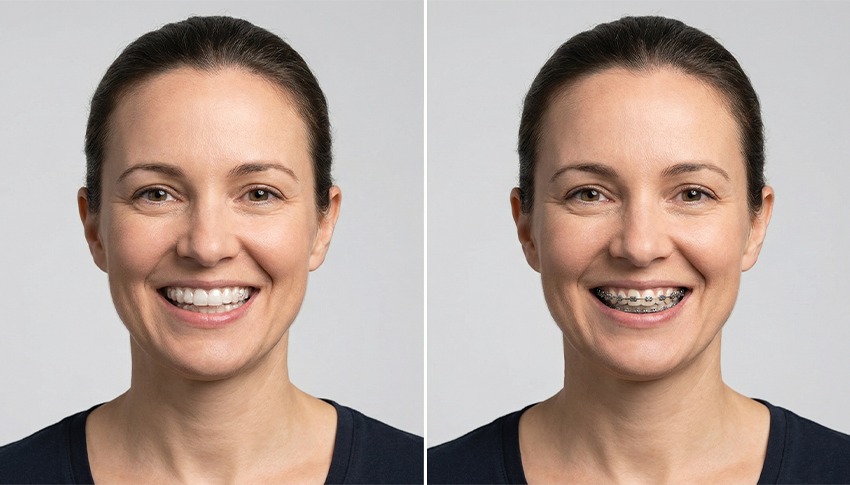
Can you recall your adolescent years? What percentage of your buddies wore braces? Maybe you did, too. Many adults may choose to straighten their teeth later in life if they did not receive braces as teenagers or if their teeth have become misaligned. What if, however, you choose not to have metal braces in your mouth? Thanks to new advancements and technology, clear aligners can help you straighten your teeth and fix tooth alignment.
But are clear aligners as effective as braces? Or are clear aligners better than braces? Let’s find out.
What Are Clear Aligners and How Do They Work?
- Contemporary orthodontic treatment for discrete teeth straightening is clear aligners. Clear aligners are constructed of clear plastic trays that are specifically designed to fit over your teeth, as opposed to traditional braces that employ metal brackets and wires.
- An orthodontist takes digital scans or impressions of the mouth during the initial appointment. These pictures aid in the creation of a series of aligners customized for every phase of therapy.
- You will move on to the next set in the series every two weeks. With regulated force, each new aligner softly moves teeth into the proper position.
- Throughout treatment, clear aligners can be taken out to improve dental hygiene during meals or when brushing and flossing. Additionally, many people find them a good option due to their nearly undetectable appearance.
What Are Braces and How Do They Work?
- A common orthodontic therapy for tooth alignment and bite problems is braces. They are made up of metal brackets that are cemented to the teeth and joined by arch wires that exert light pressure.
- An orthodontist will evaluate your dental structure during the first consultation of the procedure. After braces are installed, routine checkups guarantee that any necessary adjustments are completed. Over time, these modifications aid in guiding the teeth into their correct places.
- Braces move teeth gradually by using constant force. With this technique, tooth movement can be precisely controlled.
- Despite its initial bulk, many people quickly become used to wearing braces. They can result in notable enhancements to dental health and beauty with the proper care and attention from parents and professionals.
Pros and Cons of Clear Aligners
- Appearance: Because aligners are transparent and specially designed to suit your teeth, they are less obvious than braces. For many patients, but not all of them, this may be a factor.
- Diet: Your diet remains unaffected when you take off your aligners to eat. This means that your favorite foods will still be available to you. Certain foods are uncomfortable or challenging to consume while wearing braces, and they might break, delaying therapy and necessitating additional visits for repairs.
- Hygiene: You may brush and floss normally because your clear aligners are detachable. This is important since many individuals find it difficult to clean their teeth while wearing braces.
- Comfort: Clear aligners are generally more comfortable than braces. Because the plastic aligner is smoother than metal or porcelain braces, the lips and cheeks usually feel less uncomfortable, even if the teeth may still be a little sensitive as they start to move.
There may be some cons of clear aligners, such as:
Clear aligners are effective in treating the majority of instances, but not all of them. Your orthodontist might suggest braces instead of aligners in complicated cases. The outcome might not be as accurate if you insist on aligners, nevertheless.
Pros and Cons of Braces
- Applicable to all cases: Braces can be used to treat all cases, whereas aligners can treat the majority of them. Braces are therefore always an option.
- Variety of braces: There are several kinds of metal braces that can be colored or not. In addition, braces made of porcelain are far less noticeable than those made of metal.
- Compliance: Since the braces are affixed to your teeth, you are unable to misplace or forget to wear them. Some patients may find this helpful if they lack the internal motivation to wear their aligners as prescribed.
There may be some cons of braces, such as:
- Hygiene: Compared to clear aligners, cleaning your teeth while wearing braces is far more difficult. The teeth may sustain actual damage if cleaning is not done properly.
- Comfort: Because braces can rub on the cheeks and lips, they are often more likely to cause discomfort. This affects certain patients more than others, and it’s frequently a factor for athletes and other activity participants.
- Physical looks: Clear aligners are less apparent than braces, even those made of porcelain. Depending on their personality, interests, and line of work, this is significant for certain patients.
In the end, your unique orthodontic demands, lifestyle, and personal preferences will determine whether you choose clear aligners or braces. Although both solutions have shown results, clear aligners are notable for their flexibility, discretion, and comfort. Remember, you can make an informed decision for your path to a healthier, straighter smile by speaking with your orthodontist.