
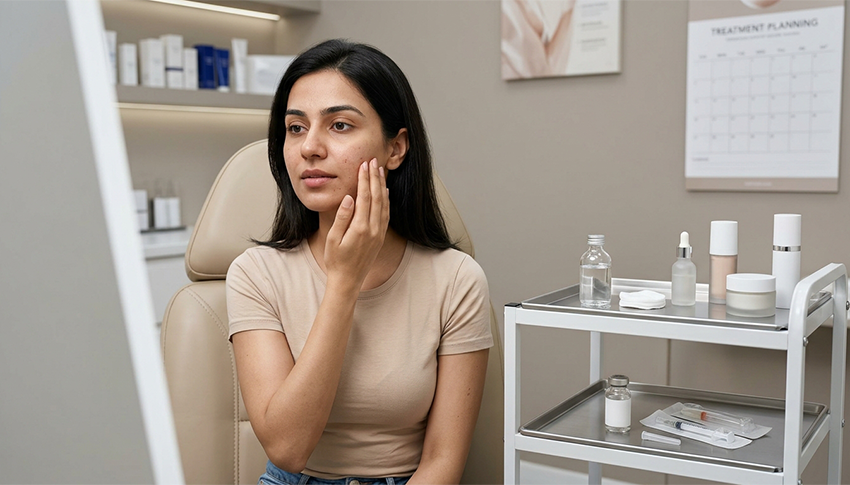
When considering chemical peels and whitening injections, it’s natural to be curious if the two treatments can be included in the same skincare plan. Both are frequently chosen by people looking for a more radiant, more even skin tone, but they work very differently.
A chemical peel is a topical procedure that exfoliates controlled layers of the skin with a chemical solution. Based on the type and strength can be used to reduce the dullness, acne marks and skin texture from the appearance. Whitening injections, however, are injectable procedures offered by some clinics as a component of cosmetic whitening plans. Remember, the important thing is how they fit each other, whether your skin meets the requirements for both, and how they must be scheduled.
Read this guide to find out more about whitening injections and chemical peels.
How Do Chemical Peels and Whitening Injections Work?
Both treatments can be incorporated into a treatment plan to improve the look of the complexion, but they work on the skin in different ways. The chemical peel is put on directly to the epidermis and works by regulated chemical exfoliation. Depending on the composition, peels can help to address uneven texture, pigmentation, acne marks and dull-looking skin.
On the other hand, whitening injections are injected into the body. Exact ingredients and protocols may vary based on the treatment offered by a clinic. The treatments work in different ways, so having one doesn’t necessarily mean you don’t need the other. Depending on your individual goals, a dermatologist may recommend either one or a combination of the two.
Can You Get Both Treatments in the Same Treatment Plan?
Sometimes, a dermatologist may include whitening injections and chemicals in the same treatment plan. But that doesn’t mean they should be done necessarily at the same appointment or without taking into consideration the condition of your skin. Treatments need to be considered separately before being combined.
Your dermatologist will take into account your skin type, coloration concerns, sensitivity, prior treatments, existing skincare products and pertinent medical history. And the type and strength of chemical peel also count. The aftercare and recovery will be very different between a superficial peel and a stronger peel. If both are available, ask your doctor why they have advised each and what function it plays in your overall plan.
Should You Get Chemical Peels Before or After Whitening Injections?
There isn’t one rule that applies to every patient. How soon or how long after depends on the particular injection treatment, the kind and strength of chemical peel, your skin state, and the protocol your doctor uses.
A chemical peel may temporarily leave the skin more sensitive, dry or irritated while it heals. That’s why it may not be wise to schedule more treatments without allowing enough time for recovery. You should get a specific timeframe from your practitioner, not have to figure out how much time to space it out yourself. If you have had a treatment before, please tell the doctor before booking a second one. Just because they are often offered for cosmetic reasons, don’t assume you can have both done back-to-back.
Does Your Skin Need Time to Rest In Between the Treatments?
Depending on the type of treatment used, the skin may be temporarily red, dry, sensitive or peel after a peel. How long you recover depends on the individual, the formulation of the peel and depth of the peel. As a general rule, be gentle with your skin during this time. Aggression may be intensified by the use of harsh exfoliants or the addition of unneeded active ingredients.
This is an important factor to consider when planning another cosmetic procedure as your dermatologist needs to know if your skin has fully recovered. If your skin is still excessively irritated, sore or inflamed, tell them before they carry out any further procedures.
What Skincare Regime Should You Follow During Treatments?
Your dermatologist may suggest gentle cleansing, moisturizing and regular sun protection after a chemical peel as your skin heals. You may also be told to avoid products that can cause more irritation for a short time.
Sunscreen is particularly essential if one of your concerns is dark spots or uneven skin tone. Sun exposure can cause tanning and pigmentation and can work against your attempts to achieve a more even-looking skin tone. Don’t pick, scrub or peel flaky skin off by hand after a chemical peel. Let your skin heal organically and follow the aftercare advice given to you by your doctor.