
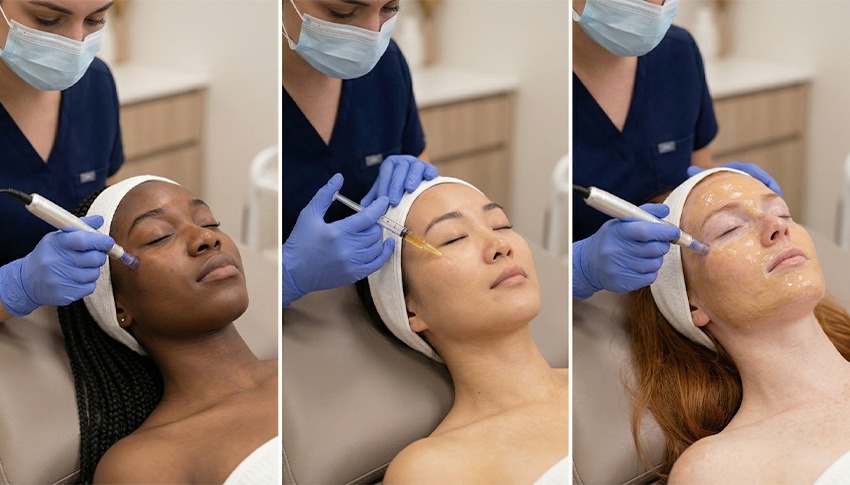
These days, cosmetic treatments that promote long-term improvement are now more important for healthy skin than rapid solutions! Instead of depending on band-aid fixes, a lot of people now seek out remedies that aid in the skin’s self-reconstruction. Due to that shift, face PRP and microneedling have become popular amongst many individuals. Both are designed to improve skin smoothness, aid in the production of collagen, and address common issues like uneven tone, fine wrinkles, and acne scars. However, these treatments differ in their mechanism, results, and recovery.
If you want to learn more about face PRP and microneedling, read this guide.
What is Microneedling?
Many people can use microneedling, a minimally invasive technique, instead of surgery to improve the appearance of their skin or address abnormalities. A handheld instrument is used to generate tiny micro-injuries to the skin across the treatment region at the start of this 30 to 60-minute process.
The body’s natural healing process and collagen synthesis will be triggered by the micro-injuries, resulting in skin that is natural, healthy, and youthful-looking. The effects of this skin-rejuvenating procedure are long-lasting, even if it may take a month or two to notice them. To maintain results, four to six follow-up sessions spaced one month or one and a half apart are advised.
Some amazing benefits of microneedling include:
- Pores that are shrunk
- Decreased scarring from acne
- Diminished stretch marks
- Reduce sun damage and aging spots
What is Face PRP Treatment?
A concentration of platelets made from your own blood is called platelet-rich plasma, or PRP. The body’s natural healing processes depend heavily on platelets. They have growth factors that promote tissue regeneration, collagen synthesis, and cell repair. Here’s how face PRP treatment works:
- Blood Drawn from Your Arm: Like a standard blood test, the procedure starts with a straightforward blood draw from your arm.
- Platelet Separation: After being drawn, the blood is put into a centrifuge, which spins it quickly. By separating the platelets from other blood components, a concentrated PRP solution is produced.
- Re-injection of PRP: This procedure targets the parts of your skin that need rejuvenation by re-injecting only the portion of your blood that has a high concentration of platelets.
Face PRP injections can target sagging skin, laxity, and volume loss while also promoting the creation of collagen. People who desire more natural and targeted results in regions that are typically more difficult to target with fillers or Botox, such as the under eyelids, marionette lines, and crepey skin on the chin, neck, and decollete, frequently choose this treatment.
Differences in How Face PRP and Microneedling Work
Microneedling: Thin needles are used in the microneedling procedure to make microscopic punctures in the patient’s skin. The skin’s natural reaction to trauma is triggered by puncturing during this therapy, which repairs the damaged skin tissue and increases the creation of collagen in the affected area. This can help seal the skin’s microchannels and supply it with elastin and collagen to make it firmer, healthier, and younger-looking. The patient’s skin type will determine how deeply the needle is punctured. In actuality, shorter needles are sufficient to stimulate the formation of collagen and elastin for skin renewal. Longer needles, on the other hand, pierce the dermal layer more deeply and fix deeper skin problems.
Face PRP: Face PRP injections are a relatively recent therapy. The patient’s own blood is used to extract concentrated plasma, which is then injected back into certain facial regions as part of the treatment. In order to separate the plasma from the remaining components of blood cells, the collected blood is simultaneously treated in a centrifuge. After that, the concentrated protein-rich plasma is injected into specific tissue-damaged areas to promote cell development. This procedure is necessary for facial rejuvenation, which makes a face appear firmer, healthier, and younger.
Which Treatment is Better?
Face PRP treatment and microneedling can rejuvenate the skin’s general tone and texture and eliminate a number of common skin issues, including wrinkles and fine lines, for someone who wishes to completely revitalize their skin without undergoing surgery. The best course of action is to use these two treatments together, also known as face PRP microneedling. Micro-injuries are made to the skin’s surface using a device that contains microscopic needles. After that, the PRP is applied topically, which enables it to enter the skin more deeply through these microchannels. Overall skin renewal, tone, and texture, fine lines and wrinkles, scars (including surgical and acne scars), and discoloration can all be greatly improved by PRP microneedling.