
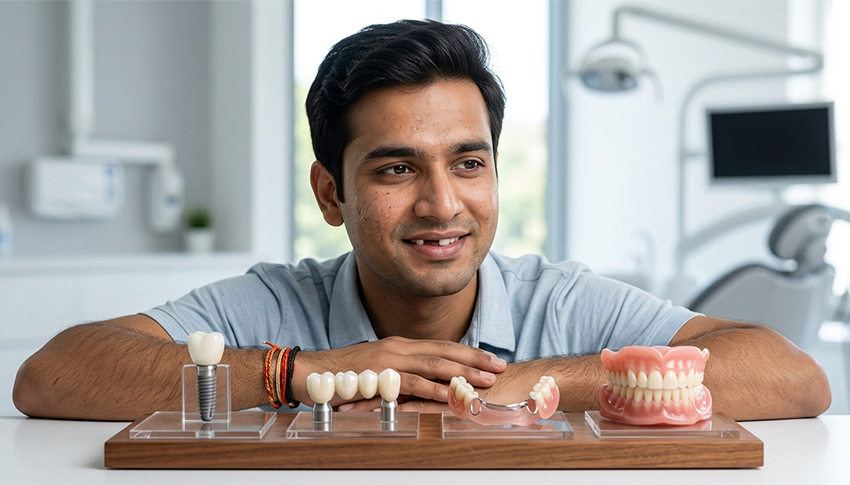
Indeed, a tooth loss can have a bigger impact than just on your smile. You might experience trouble chewing, alteration of bite, or avoidance of certain foods depending on location of the missing tooth. As time goes on, the teeth adjacent to the opening may also move, altering your bite.
The good news is that having a missing tooth doesn’t mean you have only one treatment option. There are a number of options available for replacing missing teeth in modern dentistry, depending on the specific circumstances, including the location of the missing tooth, oral health, jaw condition, and budget. Remember, it’s important to be informed about your options before making a final decision so you can have a conversation with your dentist and select a treatment that works for you and your lifestyle.
Read this guide to find out more potential treatment options to treat tooth loss.
Dental Implants
One of the most extensive solutions for missing teeth is a dental implant. Unlike the replacement of the visible crown, an implant has a small post that is inserted into the jawbone to serve as an artificial tooth root. After the implant’s successful healing and fusion with bone, a dental crown is placed over it to complete the restoration.
One of the main advantages of dental implants is that they provide a fixed replacement without requiring neighboring teeth to support the restoration. They can also help maintain the structure of the jawbone around the implant site. However, implant treatment requires adequate bone and healthy gums, and the process involves a healing period. Your dentist will evaluate your oral health and make appropriate imaging before deciding if you are an appropriate candidate.
Dental Bridges
A dental bridge can replace a missing tooth by using the neighboring teeth as support. The missing tooth is replaced by a structure known as a pontic which is placed in the space between the two neighboring teeth that are being supported by the two other crowns. A bridge is a fixed tooth replacement that cannot be taken out like a partial denture. It can also be performed in less time than certain implant procedures.
However, traditional bridges generally require the supporting teeth to be prepared. This makes the condition of those teeth an important consideration. A dental bridge may be a good solution if neighboring teeth are healthy and acceptable to hold the bridge or if an implant is not the preferred treatment. Your dentist can examine the space and neighboring teeth to see if a bridge will offer enough stability, function and esthetics.
Partial Dentures
A partial denture can be used to replace one or more lost teeth with a removable appliance. It is typically made up of replacement teeth mounted on a base that fits over remaining natural teeth. One of the advantages of a partial denture is that it doesn’t require implant surgery. It may also be a more viable treatment when multiple teeth are missing from the mouth or if the patient wants a temporary solution. The primary difference between the two is that dentures are not permanently anchored in the mouth. They need to be removed for cleaning and may feel different from natural teeth, particularly when you first start wearing them. When well-made and fitted, partial denture can be natural looking and functional.
Full Dentures
If most or all of the teeth are lost in an arch, a full denture might be an option. Complete dentures are removable appliances that are used to replace all of either the upper or lower set of teeth. They can restore basic chewing function and enhance the appearance of the smile without needing an implant per lost tooth. However, the conventional dentures do not feel quite the same as natural teeth and may require some adjustment. They can also become unstable due to the shape of the jaw changing over time. If stability is desired, implant-supported dentures may be another consideration for the patient. These use dental implants to help secure the removable denture in place. The ideal option will depend on how many missing teeth are present, the condition of the bone and gums, oral health, and the type of restoration you aren’t afraid to maintain.