
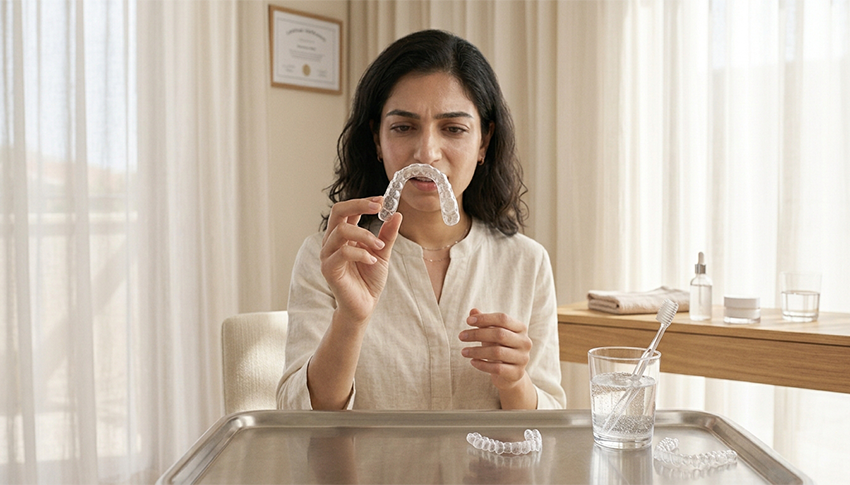
Are your aligners smelling bad? Well, don’t worry. It’s easier than you may think to fix your aligners if they smell terrible. Bacterial accumulation is nearly usually the cause of bad odor in dental appliances, and it can be successfully eliminated with regular, focused cleaning. You shouldn’t accept the problem or think it’s a natural side effect of using aligners. Instead, follow an effective cleaning routine.
Read this blog to learn more about what specifically causes your aligners to smell foul, what everyday behaviors can exacerbate it, and how regular cleaning and knowledge of the causes can make it much more bearable.
Why Do Aligners Smell Bad?
Conditions are the key to understanding why aligners smell. For 20 to 22 hours per day, clear aligners are securely placed over your teeth. The space between the tray and your enamel is made warm, moist, and low-oxygen by the tight fit. And Bacteria adore those circumstances. If given the chance, they will settle on the inside of your trays and begin to produce the sulfur compounds that provide the stale, sour odor.
Biofilm, which is essentially a sticky layer of microbial activity combined with saliva proteins, food particles, and plaque, is the technical term for what accumulates. It cannot be completely eliminated by rinsing with water. Biofilm must be broken up by chemical soaking or brushing. It thickens and the smell gets stronger when left unattended.
Eating or Drinking Without Removing Trays
Eating or drinking anything other than water is one of the quickest ways to make them smell bad. Coffee, juice, and soft drinks are examples of sugary and acidic liquids that become caught between the tooth surface and the tray. Bacterial activity is directly fueled by sugar and enamel is softened by acids. Both remnants provide a steady feeding source for germs until the tray is taken out and cleaned.
Coffee is particularly troublesome since it contains tannins that adhere to plastic surfaces and stains trays. With trays in, even a quick coffee break might leave residue that accumulates over several days to produce a detectable odor. When trays are in, the practical rule is to drink water only.
Bacteria Buildup
Our mouth constantly contains bacteria. When aligner trays provide an enclosed area for them to build up more quickly than saliva can neutralize them, the issue begins. Because saliva naturally removes waste and controls bacterial populations, it is essential for maintaining good oral hygiene. Your teeth’s natural flushing process is obstructed when a tray is placed over them.
Biofilm formation is accelerated as a result. After a few days of irregular cleaning, you may notice that your trays appear hazy or slightly yellow. The presence of germs is frequently indicated by that cloudiness. Keeping clear aligners fresh both esthetically and hygienically goes hand in hand because the scent and discoloration sometimes can appear simultaneously.
Ineffective Cleaning Practices
Although it seems sufficient to rinse trays under the faucet, the biofilm that has already stuck to the surface is not broken away. The two main methods for adequately cleaning odorous aligners are a daily soak in a specialist cleaning solution and a mild mechanical cleaning with a soft toothbrush. Bacteria quickly reestablish themselves if any step is skipped. Many people do a full nighttime cleaning but neglect the morning ritual. Bacteria get eight or more hours to thrive unhindered during the overnight window. It simply takes a few minutes to clean trays before bed and when you wake up, which covers the two highest-risk times.
How to Prevent Your Aligners Smelling Bad?
The best way to remove aligner odor is not complicated, but it does require regularity. A regular maintenance program will make sure most odors don’t occur in the first place through daily and periodic deep cleaning.
Here’s a step-by-step aligner tray cleaning routine.
- Remove trays and rinse them immediately under cool water after taking them out.
- Brush gently with a soft toothbrush. Don’t use toothpaste, because it’s too abrasive and makes more surface area for bacteria to hide in, and thus grow.
- Soak trays daily in a specialized aligner cleaning solution or cleaning crystals. A 15-to-20-minute soak will generally break the biofilm.
- Always rinse thoroughly before reinserting.
- Avoid cleaning your aligners with hot water. The plastic may become distorted from heat and may have an improper fit, which will impact your treatment results. Use cool or lukewarm water for rinsing.